




Human-in-the-Loop Veterinary AI: What it Means for Clinics
AI is moving quickly through veterinary medicine, sometimes faster than most clinics expected.
Tools that once felt experimental are now showing up in exam rooms, shaping documentation workflows, and supporting communication tasks that used to sit entirely on a clinician’s shoulders.
As these tools become more capable, the most important conversations are shifting. They center on trust, oversight, accuracy, and safety.
One phrase comes up repeatedly in those conversations: human-in-the-loop.
Veterinary leaders know they should want AI systems with human oversight. What’s less clear is what that oversight actually looks like in practice — where humans step in, what AI can safely handle, and how clinics maintain clinical control as automation increases.
Why veterinary AI still requires human oversight
AI tools can capture conversations, generate summaries, structure SOAP notes, surface reminders, and help teams complete documentation faster. Some can even suggest educational content, flag missing fields, or improve clarity.
But even the strongest AI models lack the contextual reasoning, medical intuition, and ethical accountability required in a real clinical setting.
Veterinary care involves:
- species differences
- subtle behavioral cues
- incomplete client histories
- unpredictable case patterns
- emotional nuance in client communication
There is no world where these factors can be automated away entirely. That’s why human oversight is not optional. It’s the backbone of safe, ethical veterinary AI.
The goal is not to replace clinicians. It’s to support them with tools that reduce cognitive load while keeping them firmly in control of medical decision-making.
What “human-in-the-loop” actually means in veterinary AI
The term gets used frequently, often as shorthand for “don’t worry, a human checks it.” But responsible AI systems require much more than a quick glance before signing a chart.
Human-in-the-loop, when applied correctly, means five specific things:
1. Humans supervise AI output
Clinicians review AI-generated documentation, confirm accuracy, correct details, and ensure the medical reasoning is complete before finalizing the record.
2. Humans correct AI when context is missing
AI cannot reliably interpret subtle nonverbal cues, patient behavior, or situational nuance. Humans fill the gaps.
3. Humans provide the judgment AI cannot
Differential diagnoses, risk assessments, ethical considerations, and care recommendations rely on human reasoning, not patterns or predictions.
4. Humans determine how AI fits into the workflow
Clinicians choose when to use AI, how to structure output, and how to integrate the tool into their documentation strategy.
5. Humans uphold the standard of care
AI supports quality, but humans protect it. Accuracy, compliance, medical clarity, and client communication remain human responsibilities.
Human-in-the-loop creates a partnership where AI handles the parts that are repetitive and time-consuming, and clinicians handle the parts that require expertise, empathy, and reasoning.
This combination — AI efficiency with human oversight — is what leads to strong veterinary documentation accuracy.
How human-in-the-loop AI improves veterinary documentation
Veterinary documentation is one of the areas where human-in-the-loop AI has the most immediate and measurable impact. It supports clinicians without compromising critical judgment.
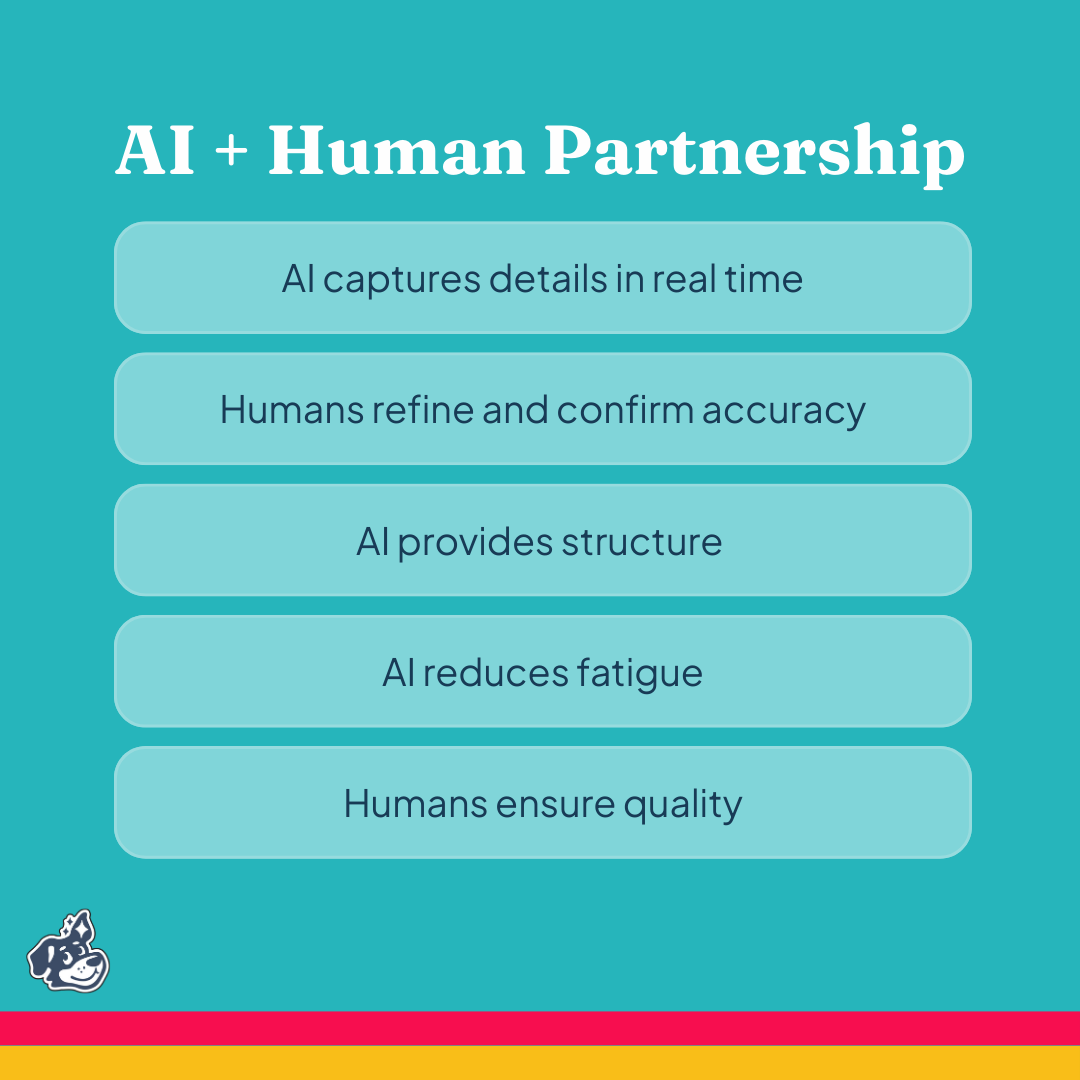
Here’s what that partnership looks like:
- AI captures details in real time. Clinicians no longer juggle memory, multitasking, or mid-conversation typing. Notes are built from the actual exam-room conversation, reducing omissions and after-hours reconstruction.
- Humans refine nuance and confirm accuracy. A clinician reviews the draft note, making small corrections or clarifications based on their observations, medical plan, and professional judgment.
- AI provides structure that enhances clarity. SOAP formatting, templated fields, and consistent organization reduce variability between doctors and improve downstream communication.
- Humans validate clinical meaning. Only a clinician knows which symptoms matter most, which details are clinically relevant, and which observations require follow-up.
- AI reduces fatigue, humans ensure quality. Clinicians spend far less time typing and far more time reviewing, which leads to higher-quality notes, fewer late-night sessions, and better overall accuracy.
This is human-in-the-loop at its most effective: AI reduces workload. Humans retain clinical authority.
What human oversight looks like in daily clinic workflows
To leaders evaluating veterinary AI, it helps to picture what human review looks like inside a real practice.
In clinics using AI-assisted documentation, human-in-the-loop documentation workflows often include:
- Clinicians previewing and approving draft notes, adding nuance to assessments or differentials
- Practice managers auditing notes for completeness and consistency
- Teams refining templates to improve accuracy over time
Human-in-the-loop is an active partnership that makes AI truly reliable. The result is fewer omissions, clearer records, and less after-hours charting, without compromising clinical authority.
How to evaluate whether a veterinary AI tool is truly human-in-the-loop
As more tools enter the market, veterinary leaders need ways to distinguish between platforms designed for clinical oversight and those that simply generate text.
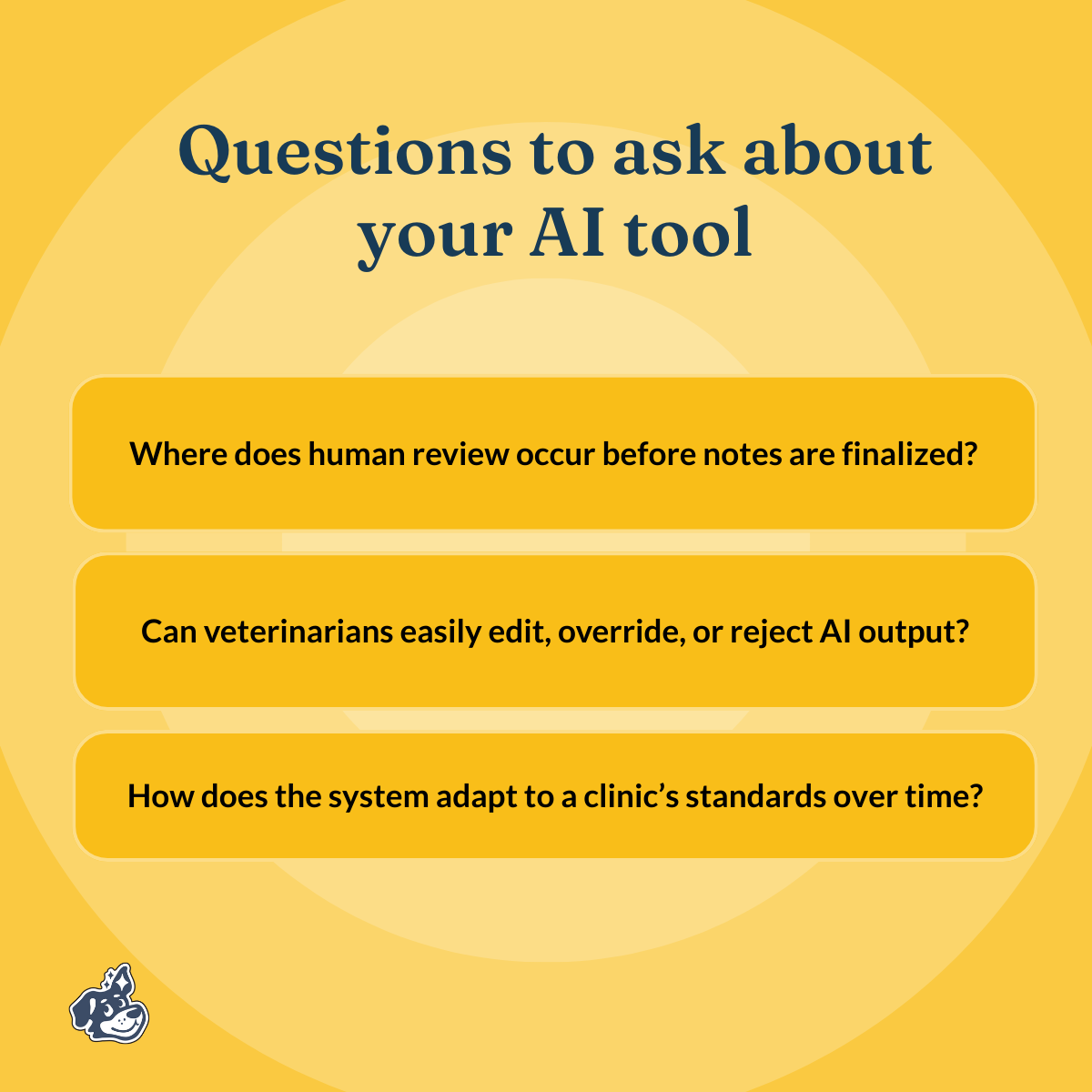
When evaluating AI documentation tools, ask:
- Where does human review occur before notes are finalized?
- Can veterinarians easily edit, override, or reject AI output?
- How does the system adapt to a clinic’s standards over time?
These questions shift evaluation from features to workflow integrity.
The future of veterinary AI: support, not replacement
Despite fears about automation, the direction of veterinary AI is not heading toward replacing clinicians. It’s heading toward supporting them by reducing administrative burden, tightening workflows, and improving accuracy so the human parts of veterinary care can flourish.
The clinics that thrive in 2026 and beyond will not be the ones who “trust AI” the most. They’ll be the ones who use AI with human oversight — thoughtfully, safely, and strategically.
Meet our AI Scribe to find out how your clinic can operate at its full potential, providing the highest level of care to every patient, every time.


.png)

.png)


