




Veterinary Clinic Automation Strategy for 2026

Veterinary clinics are already doing the hardest part of the work. They’re making complex medical decisions, building trust with clients, and caring for patients in environments that rarely go as planned. What’s been missing is not effort or expertise. It’s support.
As clinics look toward 2026, the teams that move forward aren’t trying to replace people with technology. They’re using automation as a reliable partner that absorbs the background work, protects clinical focus, and steadies the day when everything else gets unpredictable. The goal is simple: let the clinic lead, and let systems carry the load they were never meant to carry alone.
That shift changes how planning works. Instead of asking teams to stretch further, clinics are deciding what tasks technology should handle, what metrics actually reflect health, and what moments must stay human. When automation plays the role of sidekick, workflows get lighter, documentation becomes steadier, and clinicians get to practice fully present again.
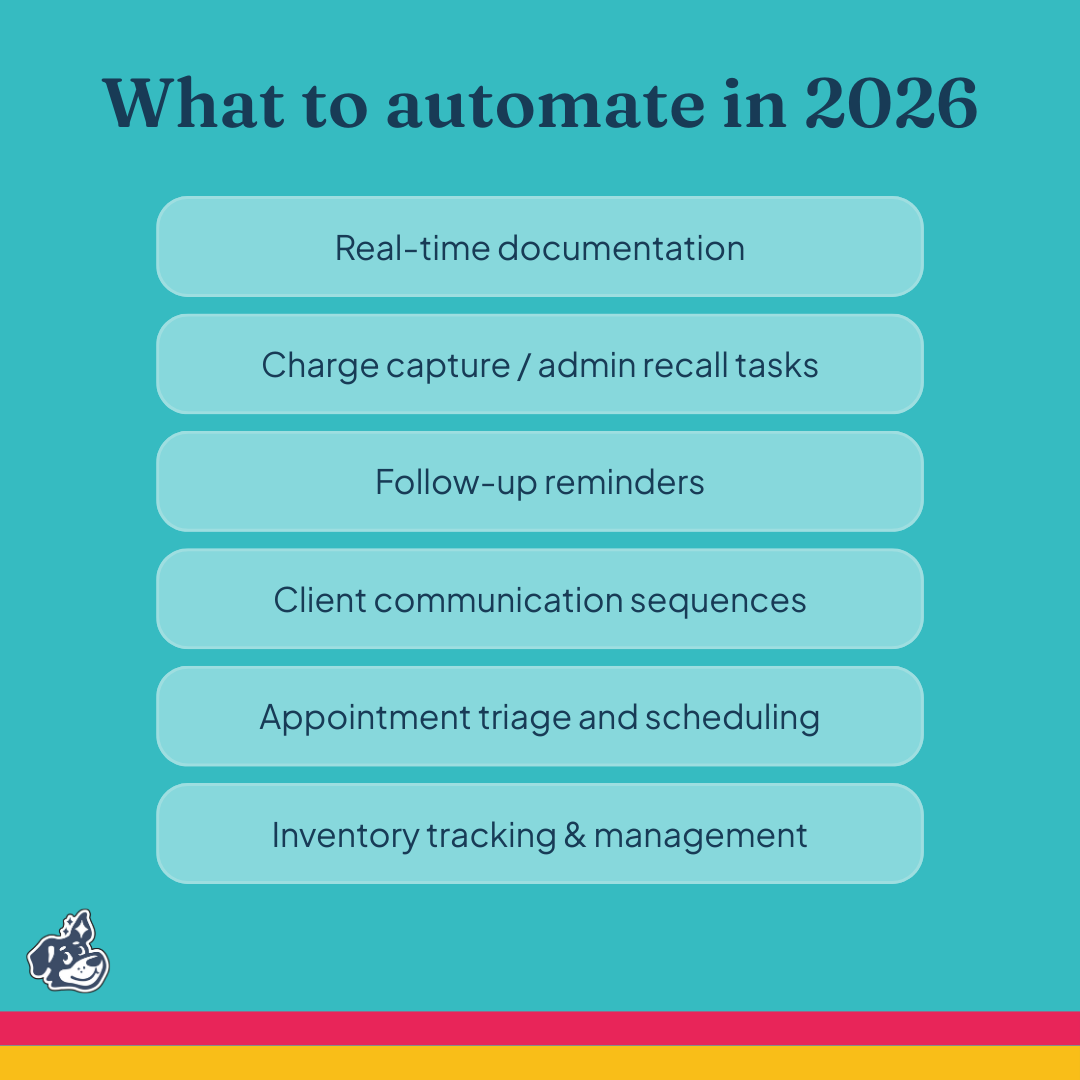
What to automate in 2026
When most people hear “automation,” they picture systems replacing human work. In veterinary medicine, that’s not the goal. The goal is to take the tasks that drain time and mental energy, but don’t require clinical judgment, and move them into repeatable, reliable, automated workflows.
Automation strategy succeeds when it frees the team to practice at the top of their skill set. In 2026, the highest-value areas for automation fall into five categories.
1. Real-time documentation and note generation
Documentation remains one of the largest operational burdens in veterinary medicine. It expands with every year, yet teams still rely heavily on memory-based workflows. That leads to late nights, inconsistent note quality, missed charges, and cognitive fatigue that carries long after the last appointment.
Real-time documentation supported by AI scribes is one of the clearest automation wins for 2026. These tools convert exam-room conversations into structured medical notes, allowing clinicians to focus fully during the appointment rather than juggling memory, multitasking, and laptop screens.
Clinics adopting AI-supported documentation see:
- dramatically reduced after-hours charting
- better accuracy because details are captured in the moment
- stronger consistency across multi-doctor teams
- faster charge capture with fewer missed services
- more emotionally present clinicians
The goal is not to automate medical judgment, but to automate the mechanical parts of note-taking so clinicians can bring their best thinking to every patient.
2. Charge capture and administrative recall tasks
Charge capture is a quiet but costly source of inefficiency. When charges aren’t entered in real time, the team must reconstruct them later — often at the end of the day, when accuracy is lowest.
Automation can simplify this through:
- prompts tied to services referenced in the note
- auto-populated charges linked to templates or exam types
- verification reminders that alert teams to discrepancies
- mid-day charge audits that surface omissions early
AI scribes add another layer of accuracy by ensuring services mentioned in the exam-room conversation appear directly in the documentation, reducing the guesswork later.
This is one of the most important parts of a 2026 automation strategy because it directly affects revenue, client communication, and operational stability.
3. Follow-up reminders and client communication sequences
Many client communication tasks follow predictable patterns: recheck reminders, vaccine schedules, lab result updates, medication follow-ups, and surgery aftercare.
When these workflows rely solely on humans, inconsistency is inevitable — not because the team doesn’t care, but because the day is too unpredictable.
Automated communication workflows:
- prevent missed follow-ups
- smooth CSR capacity
- reduce cognitive load on clinicians
- create predictable, timely client experiences
- improve adherence and continuity of care
Automation should handle the routine so humans are available for the moments that require nuance.
4. Appointment triage and scheduling
A strong automation strategy also reduces scheduling friction. Online intake forms, automated triage logic, and guided scheduling tools can filter appointment needs and slot them appropriately.
When used well, scheduling automation:
- reduces double-booking
- clarifies urgency
- routes cases to the right provider
- decreases CSR decision fatigue
- makes the day more predictable
This is especially important as client messaging increases and same-day requests become harder to absorb manually.
5. Inventory tracking and supply management
Automated thresholds and alerts reduce emergency orders, prevent overstocking, and eliminate the “we’re out of that again?” moments that disrupt workflow.
This is not glamorous automation, but it is foundational. Predictable inventory equals predictable care.
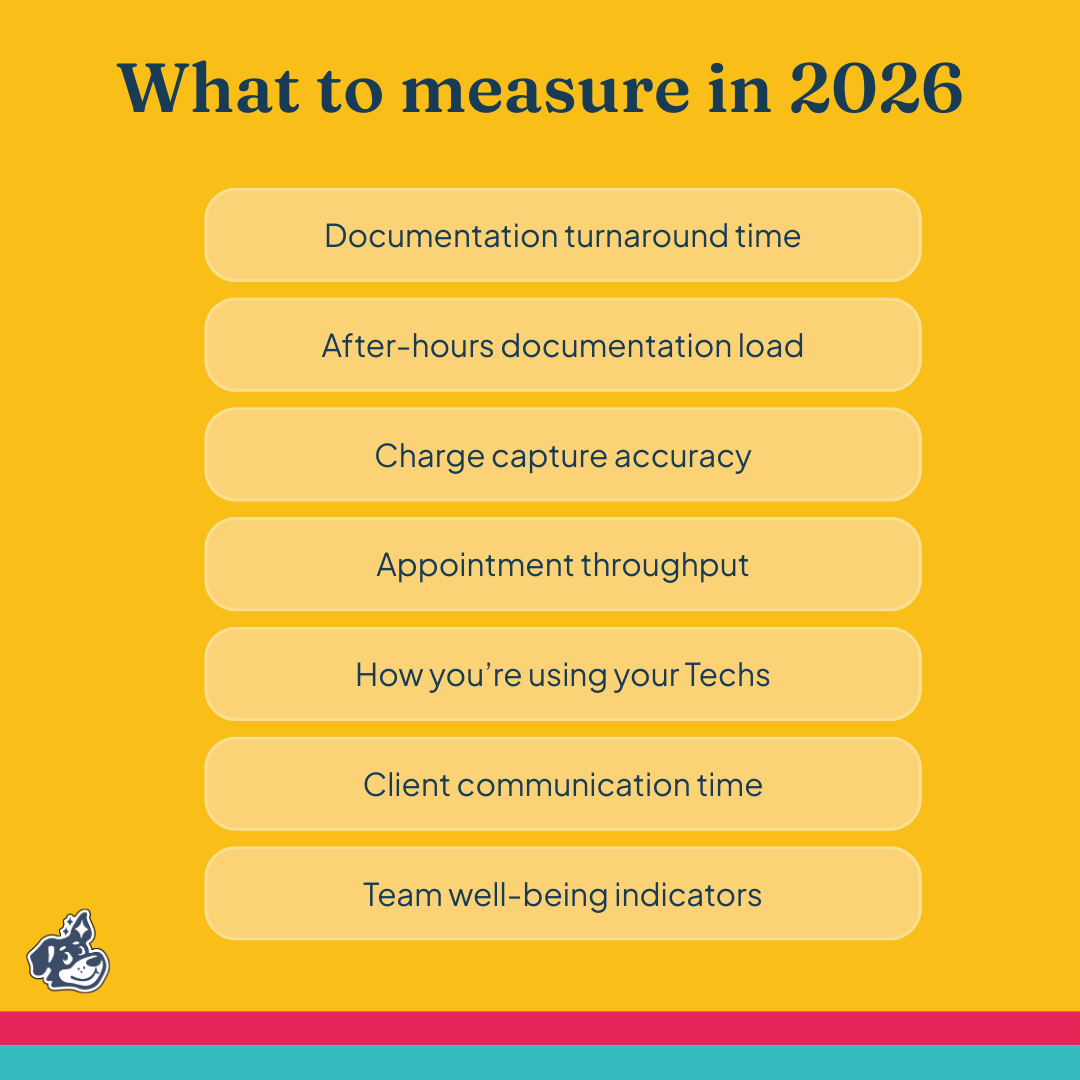
What to measure in 2026
Veterinary planning often collapses into guesswork because leaders don’t have a clear operational scorecard. 2026 requires more visibility — not in the form of dashboards for their own sake, but in the form of metrics that directly reflect workflow health, documentation strategy, and team well-being.
These are the measurements that matter.
1. Documentation turnaround time
One of the clearest markers of operational stability. Strong clinics aim for documentation within minutes or hours of the appointment — not at 9 p.m. at home.
When note delays shrink, everything downstream improves: charge capture, communication, medical accuracy, and clinician well-being.
2. After-hours documentation load
If clinicians are finishing notes at night, the system is breaking somewhere. This metric should move toward zero in 2026. It’s one of the most powerful indicators of clinic health.
3. Charge capture accuracy
Missed or corrected charges reflect workflow gaps, rushed documentation, or inconsistent processes. As clinics automate real-time documentation, this metric becomes far easier to improve.
4. Appointment throughput — without additional strain
Throughput is not about squeezing more into the schedule; it’s about reducing the friction that makes days run over.
The key questions:
- Are appointments consistently running late?
- Where are the bottlenecks?
- How long does each stage of the visit actually take?
Throughput is a workflow health metric, not a productivity metric.
5. How you’re using your Techs
High-performing clinics measure whether technicians are doing the work they’re trained for — or whether administrative friction is pulling them away.
Better documentation strategy, automation, and workflow design all expand technician bandwidth.
6. Client communication time
How long does it take to close the loop with clients?
Delays in callbacks, lab results, or discharge instructions often signal either documentation gaps or lack of workflow clarity. Automation and real-time documentation reduce this cycle dramatically.
7. Team well-being indicators
Good automation strategy improves retention, reduces burnout signals, lowers overtime, and stabilizes morale. These are operational metrics, not just HR metrics.
2026 planning should treat them as such.
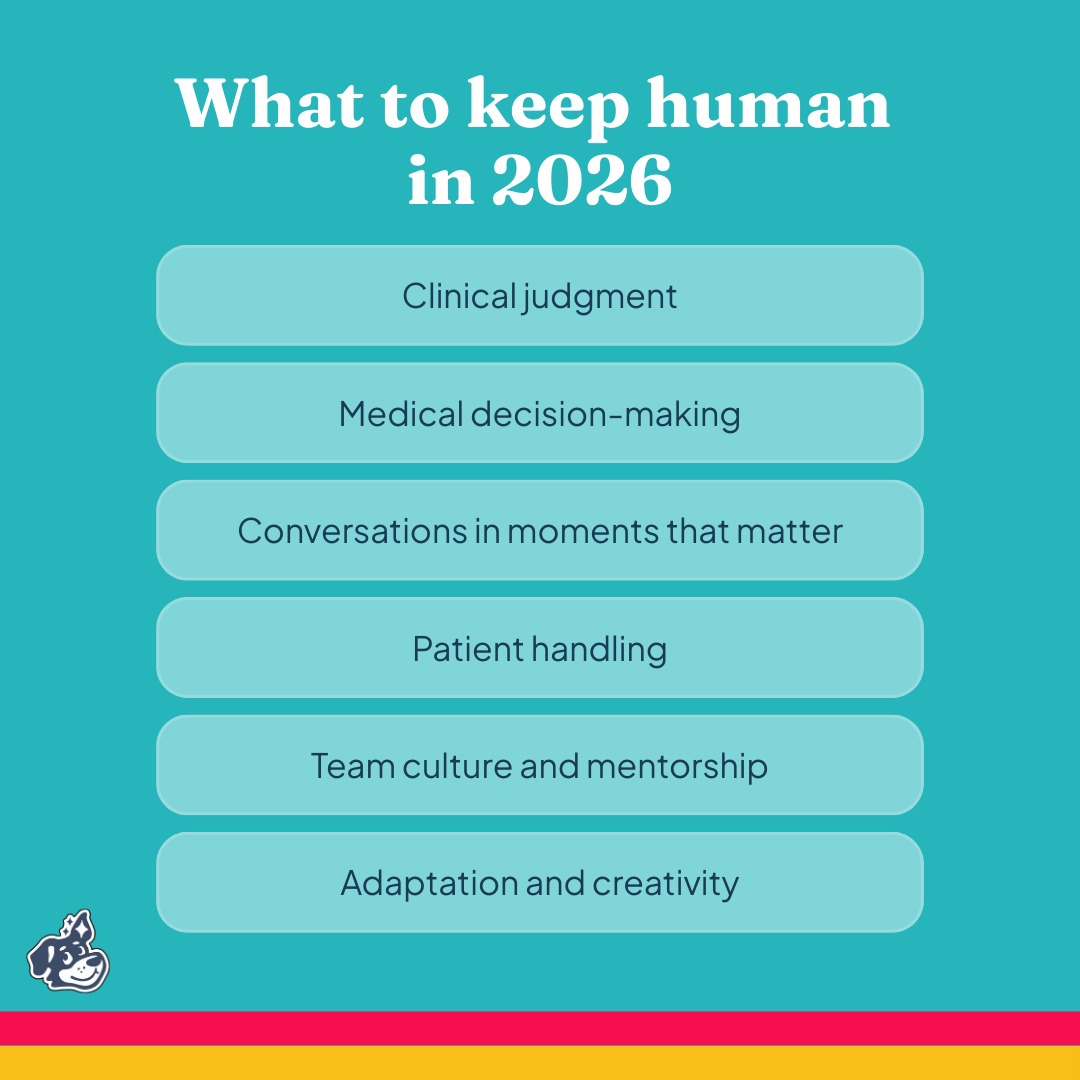
What to keep human in 2026
Automation is powerful, but it cannot (and should not) replace the parts of veterinary care that depend on empathy, judgment, and connection.
These human elements are not inefficiencies — they’re the core of the profession. The 2026 playbook should explicitly protect them.
Clinical judgment and medical decision-making
Automation can surface information, track details, or speed documentation — but it cannot replicate nuance, interpretation, or the synthesis of a complex case. These remain firmly human.
Conversations in moments that matter
Discussing diagnoses, uncertainty, treatment options, financial decisions, or quality-of-life considerations requires emotional intelligence. These moments shape trust and define the client experience.
Automation should clear space for these conversations, not interrupt them.
Patient handling and the human-animal bond
No technology replaces the hands-on work of calming a nervous patient, reading subtle behavior cues, or building trust with an anxious pet owner.
Team culture, mentorship, and conflict resolution
Workflow stability helps culture, but it doesn’t create it. Coaching, feedback, alignment, and shared learning are human-driven processes. Automation simply frees up the bandwidth to invest in them.
Adaptation and creativity in unpredictable cases
Cases that fall outside established patterns require flexible thinking. Humans adapt. Technology supports.
This is why the best automation strategies in 2026 work with clinicians — never instead of them.
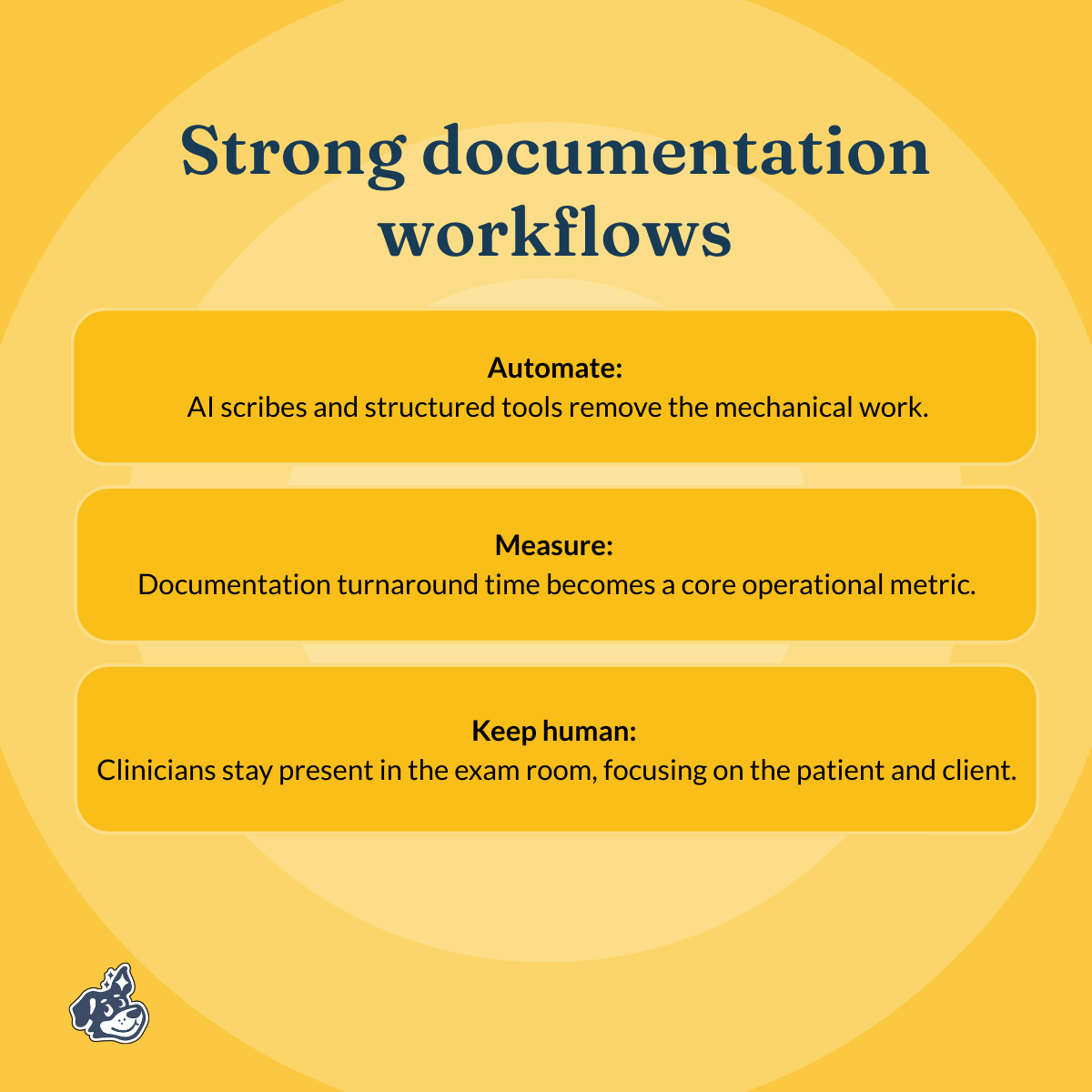
The intersection of automation, measurement, and humanity: documentation as the center point
Documentation sits at the crossroads of all three pillars:
- Automate: AI scribes and structured tools remove the mechanical work.
- Measure: Documentation turnaround time becomes a core operational metric.
- Keep human: Clinicians stay present in the exam room, focusing on the patient and client instead of trying to remember details for later.
2026 will reward vet clinics that plan with intention
The veterinary teams that thrive next year won’t be the ones who push harder. They’ll be the ones who redesign their workflows, automate the right tasks, measure what matters, and protect the human elements that make care meaningful.
When clinics adopt intentional strategies:
- Documentation stops spilling into evenings
- Charge capture becomes simpler and more accurate
- Throughput becomes smoother without additional strain
- Communication becomes more predictable
- Teams feel supported, not stretched
- Clients experience more clarity and confidence
This is the real promise of 2026: not a year of doing more, but a year of doing the right work in the right way, with technology supporting the team, not overwhelming it.
A strong future for veterinary medicine starts with better planning, clearer priorities, and workflows that let humans be fully human again.
Transform your clinic with HappyDoc
Let HappyDoc help you transform your entire approach to patient care. Your clinic's staff will have a personalized AI assistant that works alongside you so you can be free to focus on what matters: your patients.
Schedule a demo to find out how your clinic can operate at its full potential, providing the highest level of care to every patient, every time.


.png)

.png)


