




What Information Does an AI Scribe Capture in Vet Visits
AI scribes are becoming more common in veterinary clinics, but many teams still have the same core question before adopting one: What information is actually being captured during the visit?
This is a fair concern. Documentation is not just a record of what happened. It shapes follow-up care, client communication, internal handoffs, and compliance. If an AI scribe only captures fragments of the conversation or misses nuance, it creates more rework instead of less.
Modern veterinary AI scribes are designed to capture far more than basic dictation. When implemented well, they document the full clinical conversation in real time and keep that information usable throughout the workflow, during the visit, immediately after, and across future care.
Why this question matters in real veterinary workflows
Veterinary visits are complex. They involve multiple speakers, evolving decisions, cost conversations, and real-time explanations. Notes are rarely written exactly as the visit unfolds, which is why so much charting happens after hours.
Understanding what an AI scribe captures helps teams answer three critical questions:
- Will my notes reflect what actually happened?
- How much editing will I need to do afterward?
- Can I trust this documentation for continuity of care?
The difference between a helpful AI scribe and a frustrating one comes down to how well it captures context, not just words.
Core clinical information an AI scribe captures
At its foundation, an AI scribe supports veterinary SOAP notes, organizing information into a familiar structure while capturing it in real time.
Subjective information
AI scribes capture the subjective portion of the visit by listening to the natural conversation between the veterinarian, client, and care team. This includes:
- The client’s stated concerns
- History shared verbally
- Timing, progression, and context around symptoms
Because this information is captured during the visit, it reflects the client’s actual language and priorities, rather than a shortened summary written later from memory.
Objective findings
When objective observations are spoken aloud, an AI scribe captures:
- Physical exam findings discussed during the visit
- Vital signs that are verbalized
- Observable behaviors mentioned in real time
AI scribes do not infer or invent data. They document what is explicitly stated, which preserves accuracy and clinical integrity.
Assessment and clinical reasoning
One of the biggest advantages of modern AI scribes is their ability to capture clinical reasoning, not just outcomes.
This includes:
- Differential diagnoses discussed with the client
- Clinical impressions explained during the exam
- Risk factors or concerns noted aloud
This layer of documentation is often abbreviated or skipped in traditional notes due to time constraints, even though it is critical for continuity and legal clarity.
Plan and next steps
AI scribes capture the agreed-upon plan as it is discussed, including:
- Diagnostics recommended and approved
- Treatments and medications
- Preventive care guidance
- Follow-up timelines
Because the plan is documented in context, it aligns more closely with client understanding and expectations.
How captured information stays usable beyond the note
Capturing the visit is only the first step. In real clinics, teams need to revisit decisions, clarify what was communicated, prep for upcoming appointments, and hand cases between providers.
This is where AI Assistants go beyond passive documentation. Instead of locking captured information inside a single SOAP note, they keep it accessible across the medical record so teams can work with it later without rereading charts or rewriting notes.
Capturing information is only useful if you can interact with it
HappyDoc’s AI assistant, Scout, builds on what the scribe captures by making that information searchable, editable, and usable across visits. Scout works with the documentation created during the appointment and understands:
- What was said during the visit
- What made it into the medical record
- How this visit fits into the patient’s broader history
This allows teams to interact with captured information instead of recreating it.
Clarifying what was discussed without rereading the chart
When questions come up later, teams should be able to get clear answers quickly.
With Scout, veterinarians and staff can ask natural-language questions like:
What did we tell the owner about prognosis last December?
Scout reviews the actual visit conversation and documentation to summarize what was discussed, what wasn’t, and where follow-up may be needed. This is especially helpful in multi-doctor practices or emotionally complex cases, where nuance matters as much as clinical detail.
Editing captured information without breaking flow
Even with strong real-time capture, occasional updates are inevitable.
Instead of reopening records, finding the right field, and retyping, teams can use Scout to make targeted updates:
Add that Neo-Poly-Dex was given OD.
Scout places the update in the correct section and prompts for confirmation. This keeps documentation accurate without pulling focus away from patient care or adding after-hours cleanup.
Turning captured visits into usable clinical summaries
Over time, captured information compounds. Scout can generate structured clinical summaries that include:
- Chronic conditions
- Current medications
- Key past visits
- Treatments tried
- Diagnostic trends
- Important considerations going forward
These summaries reduce cognitive load during hand-offs, referrals, and complex follow-ups, particularly for senior patients or long-running cases.
Non-clinical context that still matters
Veterinary visits are not purely medical. AI scribes also capture information that affects care delivery and follow-through.
Cost and care conversations
Modern AI scribes document:
- Pricing discussions
- Declined or deferred services
- Phased or tiered care decisions
Because Scout understands both what was discussed and what was documented, it can help surface gaps or clarify context later, supporting clearer client follow-ups and fewer misunderstandings.
Client questions and decision points
AI scribes capture:
- Questions clients ask during the visit
- Clarifications provided by the veterinarian
- Moments where consent or agreement is reached
This reduces ambiguity and supports better client communication after the visit.
How AI scribes handle multi-speaker exam rooms
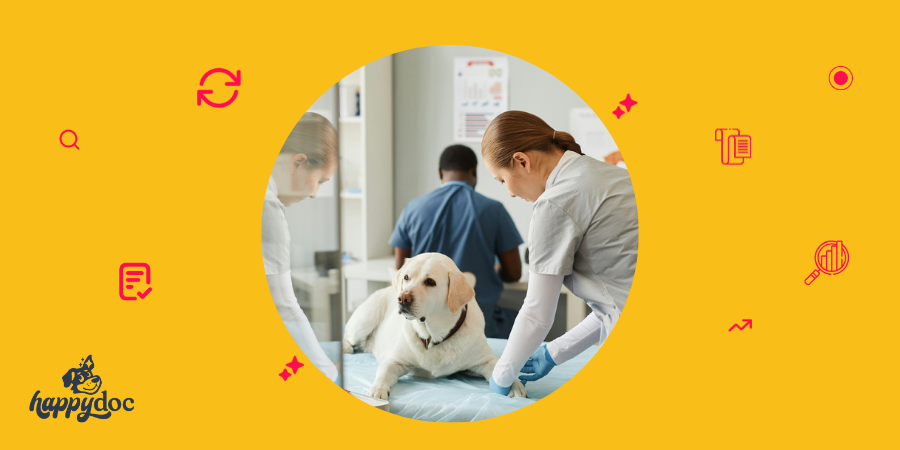
Veterinary exam rooms are rarely quiet or linear. Conversations involve veterinarians, technicians, assistants, and clients, often speaking over one another or jumping between topics.
AI scribes designed specifically for veterinary medicine can:
- Distinguish between speakers
- Maintain context across interruptions
- Capture back-and-forth explanations accurately
This is a critical difference between AI scribes and basic voice-to-text tools, which often struggle in dynamic, multi-speaker environments.
What an AI scribe does not capture
It is equally important to understand what an AI scribe does not capture.
AI scribes do not:
- Record private side conversations
- Capture silent observations unless spoken
- Replace clinical judgment
They are documentation tools, not decision-makers. Their role is to support accurate records, not to dictate care.
Turning captured information into usable documentation
Capturing information is only useful if it turns into clean, usable notes.
Modern AI scribes structure captured data into organized SOAP notes automatically. With HappyDoc, this includes:
- Clear sectioning
- Consistent formatting across providers
- Notes that are ready for review, not rewriting
HappyDoc also supports review, regenerate, and edit-in-place workflows, allowing clinicians to:
- Regenerate specific sections if needed
- Edit directly without starting over
- Finalize notes quickly while the visit is still fresh
This directly improves vet documentation efficiency and reduces after-hours charting.
How HappyDoc captures information differently
HappyDoc is built specifically for veterinary workflows, not adapted from human medicine or generic dictation tools.
Instead of treating documentation as transcription, HappyDoc:
- Captures context, not just words
- Understands veterinary-specific language
- Adapts to different appointment types
- Integrates directly into existing PIMS workflows
Because HappyDoc is designed around real exam room dynamics, the notes it produces feel like accurate clinical records, not rough drafts.
Why accurate capture reduces downstream work
When documentation accurately reflects the visit, downstream work decreases.
Clear, structured vet notes change the dynamic for front desk and support teams. When notes reflect the full exam room conversation and power client-facing summaries:
- Clients leave with fewer unanswered questions
- Callbacks decrease
- Follow-up instructions are clearer
- Teams spend less time fixing or clarifying records
This allows staff to focus on real-time support instead of damage control.
What to expect when using an AI scribe for the first time
Most clinics are surprised by how quickly AI scribes can be used effectively.
With HappyDoc:
- Setup can happen the same day
- Clinicians can use it immediately as a scribe
- Trust builds faster than expected
The learning curve is not technical. It is about seeing accurate notes consistently and realizing how much mental load has been removed.
Choosing an AI scribe that fits real veterinary visits
When evaluating an AI scribe, clinics should look for:
- Contextual capture, not just transcription
- Support for multi-speaker exam rooms
- Structured SOAP notes
- Easy review and editing
- Seamless integration into existing systems
AI scribes work best when they align with how veterinary medicine is actually practiced.
See how HappyDoc captures real exam room conversations
HappyDoc’s AI scribe is designed to support real veterinary visits, not idealized workflows. It captures the full clinical conversation, turns it into accurate SOAP notes, and reduces the rework that leads to burnout.
If you want to see how HappyDoc works in your clinic, schedule a demo and experience documentation that reflects the care you already provide.


.png)
.png)


