




What Thousands of Vet Visits Reveal About the State of American Pet Care

On any given day in America, tens of thousands of veterinary clinics see a combined half million pets. Routine wellness exams. Vaccination appointments. Chronic condition check-ins. Senior pets with complicated histories and worried owners. Each of those visits contains information that, taken alone, tells the story of one animal and one family. Taken together, they tell the story of an entire industry.
That is the premise behind our new report: "A Day In America's Pet Clinics." This report surfaces anonymized, de-identified patterns from across the clinics where our AI in veterinary medicine platform operates. On a single day at the beginning of this summer, we analyzed thousands of visits across nearly 300 clinics. No clinic names, no doctor names, no client information was retained. What remained were patterns: the kind that only become visible when you can look across thousands of appointments at once.
HappyDoc has partnered with clinics on over 2 million visits, and here's what we've learned: American veterinary medicine is staffed by knowledgeable, dedicated clinicians doing difficult work under significant pressure, leading to high burnout rates and soaring costs for clinics and their clients. When we looked in the data for the cause of that pressure, we found a set of recurring friction points, places where the gap between best-practice care and real-world delivery is widest, and where better tools and workflows could meaningfully shift outcomes.
Here is what the data revealed.
Cost Is the Undercurrent Running Through Every Visit
Before diving into specific clinical categories, one finding deserves to stand on its own: cost is the single most pervasive factor shaping veterinary care in America today. It appeared as the top owner concern across nearly every category we analyzed, surfacing in more than 15% of all visits in our dataset.
Owners are actively price-shopping in the exam room. Chewy, Costco, and Amazon were mentioned repeatedly across visits as alternative sourcing channels for medications and preventive products that were recommended by the veterinarian on the same day. In visit after visit, clinicians made the right clinical recommendation, and owners walked out to find a lower price online.
At the same time, only a small fraction of visits showed clinicians proactively addressing cost before owners raised it. This is not a criticism of individual veterinarians. It reflects a workflow problem. When cost transparency is not built into the care process, the conversation defaults to the owner bringing it up, often at the point of decline.
The practices that proactively engaged on pricing had better outcomes. Not because they discounted care, but because they named the tension before it became a barrier.
Senior Pet Care: A Reactive Posture When Proactive Is Possible
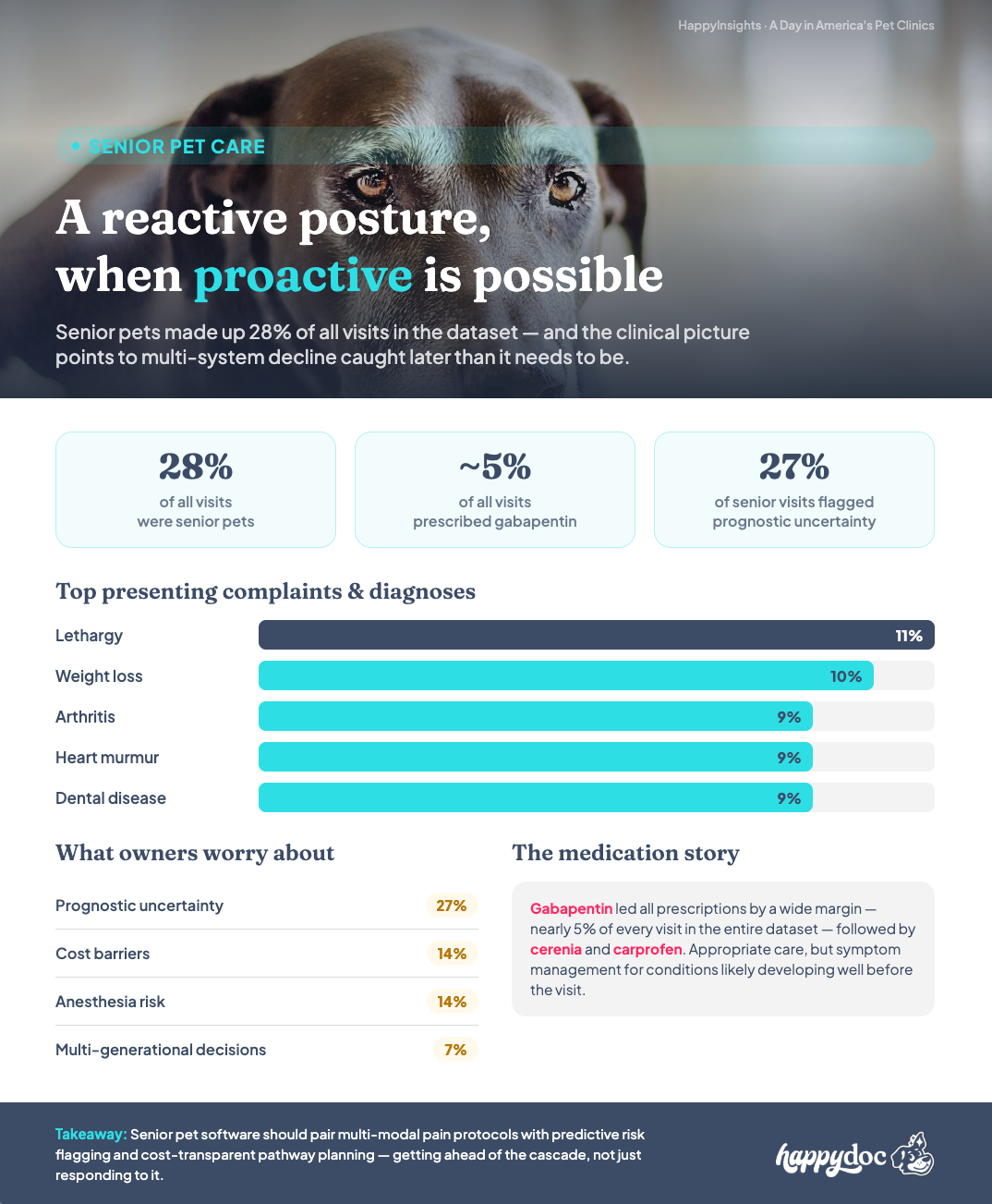
Senior pets represented one of the largest segments in our dataset, accounting for 28% of all visits. The clinical picture that emerged was one of multi-system decline: lethargy and weight loss appeared as the top two presenting complaints, surfacing in 11% and 10% of senior visits respectively, while arthritis, heart murmurs, and dental disease each appeared in roughly 9% of senior diagnoses.
The medication profile told the same reactive story. Gabapentin led all prescriptions by a wide margin, appearing in nearly 5% of all visits in the dataset, followed by cerenia and carprofen. These are appropriate interventions, but they represent management of symptoms that may have been developing for some time before the visit.
Owner anxiety in senior pet visits centered on three concerns: prognostic uncertainty (27% of senior visits), cost barriers (14%), and anesthesia risk (14%). In 7% of senior visits, care decisions were being made by more than one family member, often under financial strain.
Industry Implication?
The interconnected nature of senior pet pathology means that one untreated condition accelerates others. Poor oral health drives appetite loss, which accelerates weight decline, which stresses the cardiac and musculoskeletal systems. AI in veterinary medicine offers a genuine opportunity here: predictive risk flagging, polypharmacy interaction alerts, and cost-transparent pathway planning could help clinicians get ahead of the cascade rather than responding to it after it begins.
Takeaway
Senior pet management software should integrate multi-modal pain protocols, predictive risk flagging for polypharmacy interactions, and cost-transparent pathway planning to address the trifecta of owner concern—prognosis uncertainty, financial pressure, and anesthesia risk.
Vaccination: Bundled into Wellness When It Should Stand Alone
Vaccination remains deeply tethered to wellness visits rather than treated as a standalone prevention priority. Of the visits where vaccination was the central topic, nearly half listed a wellness exam as the primary reason for the appointment, with vaccine updates driving an additional 32%. Only 21% of vaccine-related visits were scheduled specifically as vaccination appointments.
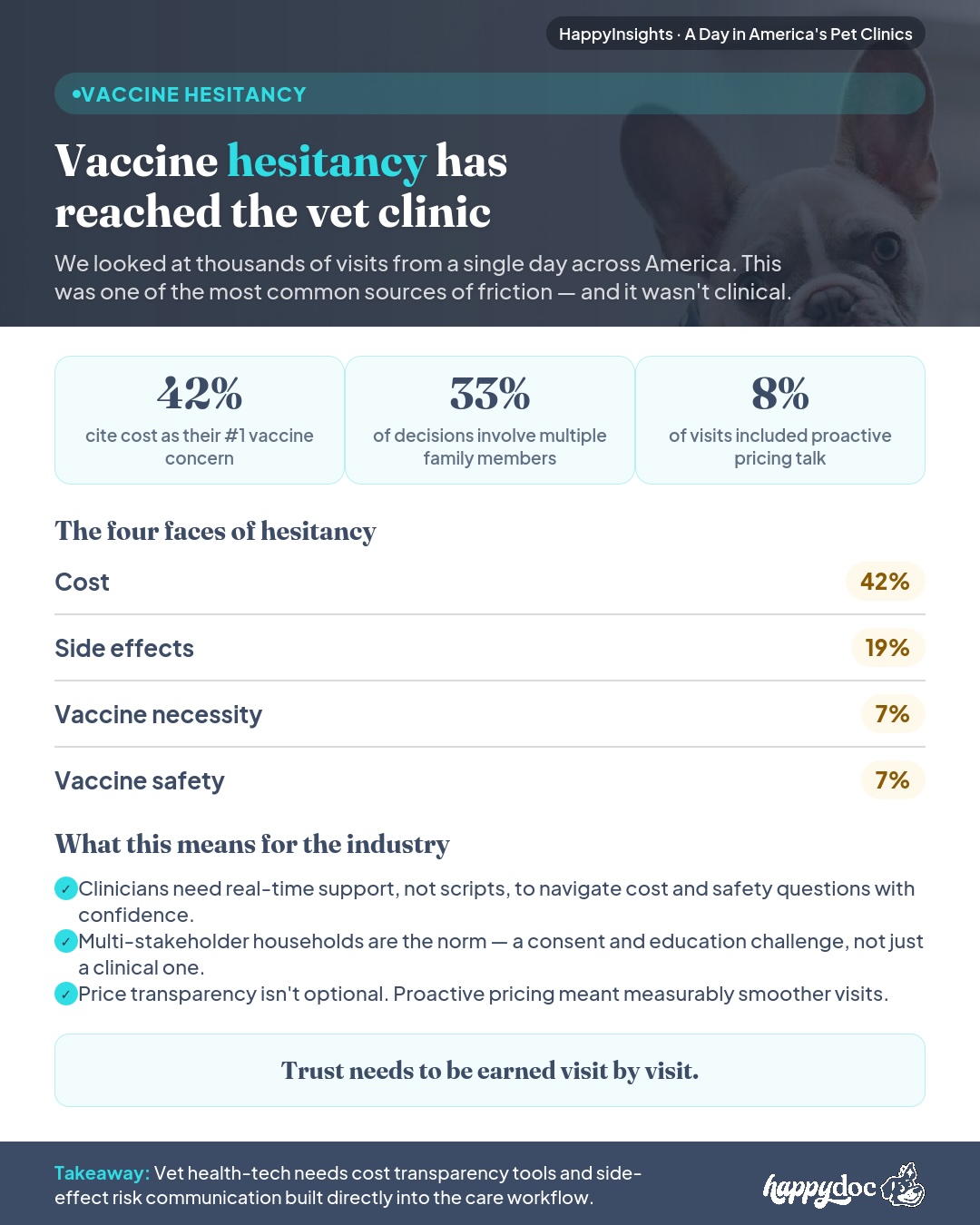
Owners voiced real concerns: side effects appeared in 19% of vaccine-related visits, and questions about vaccine necessity and safety surfaced in roughly 7% each. Cost was again the dominant owner worry, appearing in 42% of vaccine-adjacent visits.
In 33% of vaccine-related visits, vaccination decisions involved family members beyond the primary caregiver, adding complexity to consent and health literacy conversations that the standard 20-minute appointment format is not designed to accommodate.
Industry Implication?
Clinicians who addressed pricing proactively (8% of vaccine visits) and who used structured educational frameworks during vaccine discussions (12%) had smoother encounters. The tools to systematize this approach, including cost transparency modules and side-effect risk communication support, are exactly where AI in veterinary medicine can reduce friction.
Takeaway
Veterinary health-tech platforms should develop cost transparency tools and side-effect risk communication modules that help owners navigate trade-offs between vaccine necessity and household budget concerns, while supporting clinicians in managing multi-stakeholder decision-making.
Wellness Visits: The Highest-Leverage Touchpoint in the Client Relationship
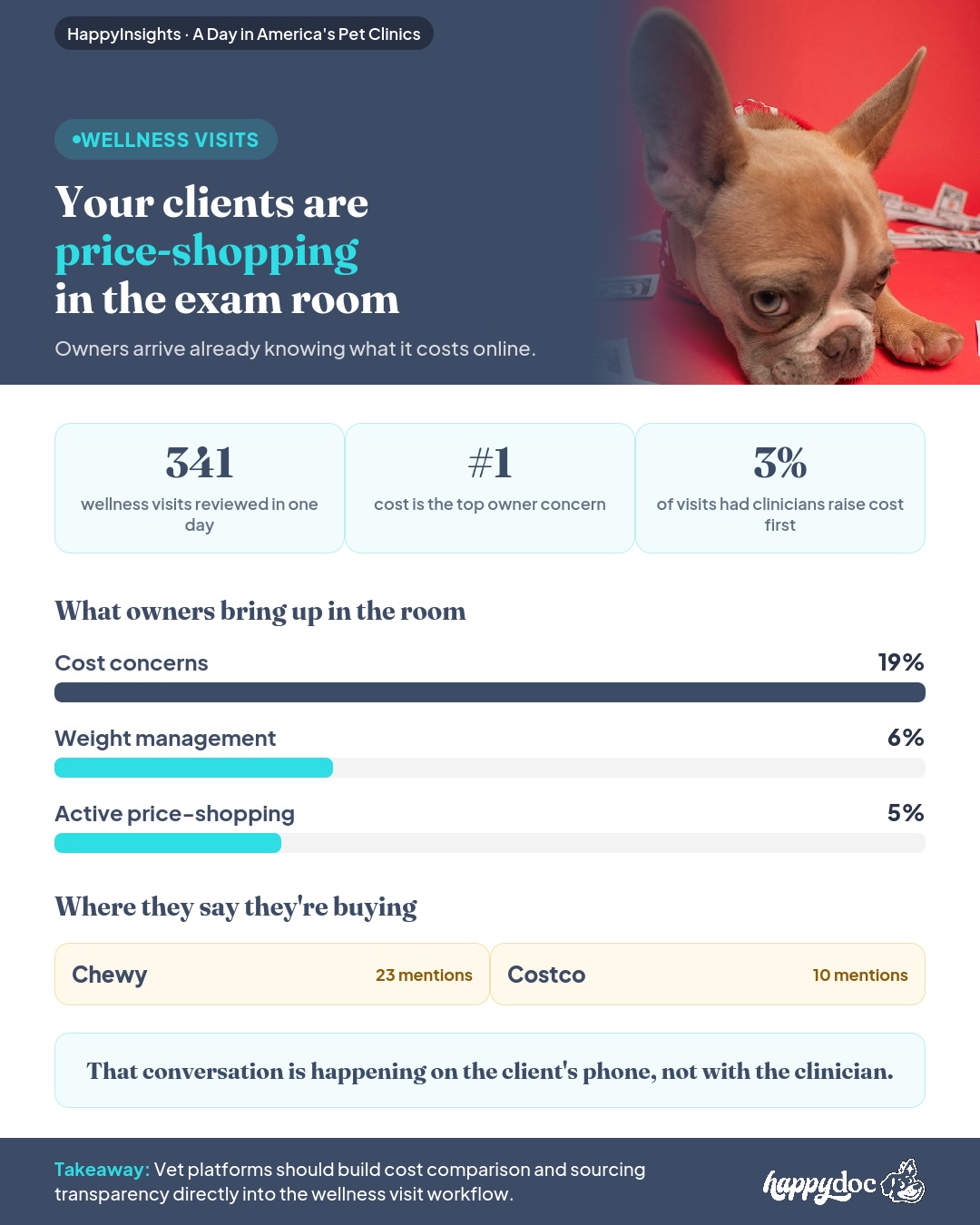
Wellness visits accounted for 17% of all appointments in our dataset, making them the single largest category. They are the backbone of veterinary practice, and they are also where the gap between clinical opportunity and financial reality is most visible.
Cost concerns appeared in 19% of wellness visits. Active, in-room price-shopping behavior was documented in 5% of wellness appointments. Chewy alone was mentioned in more than 1% of all visits in the dataset. Only 3% of wellness visits showed clinicians proactively addressing cost before owners raised it.
At the same time, dental disease was the most commonly incidental finding during wellness exams, appearing in roughly 5% of wellness diagnoses. Weight management concerns appeared in 6% of wellness visits, with overweight diagnoses documented in 5% of routine checks.
One pattern worth noting is the appearance of anxiety management medications, including gabapentin and trazodone, in what were otherwise routine wellness appointments. Owners are using these scheduled visits to raise behavioral concerns they have been sitting with. The wellness visit is doing more clinical work than its name suggests.
Industry Implication?
A well-supported wellness workflow, one that integrates SOAP notes with cost comparison tools, multi-product sourcing transparency, and structured talking points on dental and weight management, would convert more of these high-potential visits into completed preventive care plans. When SOAP notes are built to surface the right prompts at the right moment, clinicians spend less time reconstructing the visit and more time having the conversations that actually move care forward.
Chronic Allergies: A High-Touch Problem Without Enough Support
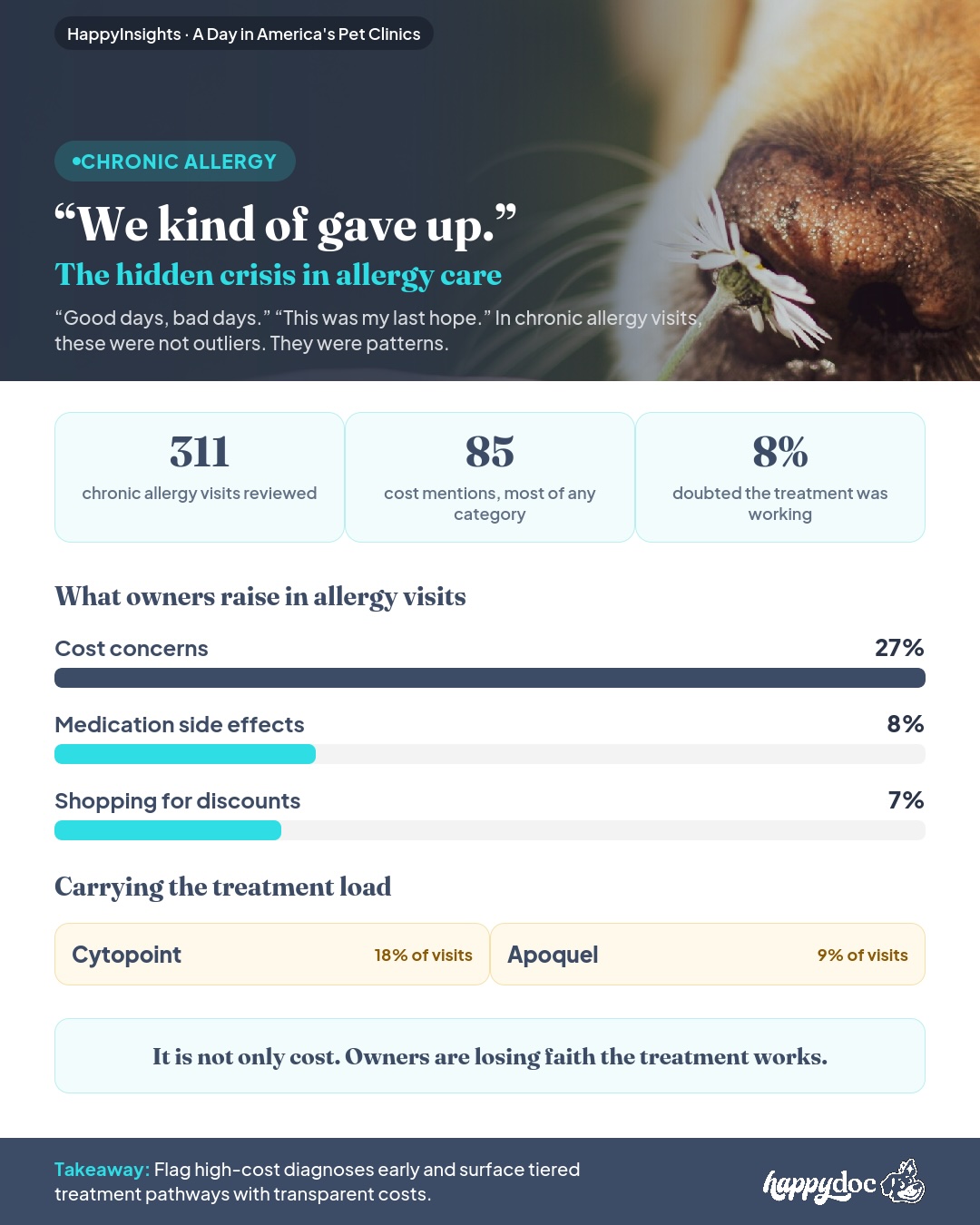
Chronic allergy management generated 16% of all visits in our dataset, and it was the most emotionally weighted category we analyzed. Owner language in these appointments included phrases like "we kind of gave up," "this was my last hope," and "good days, bad days." These were not outliers. They were patterns.
The clinical picture is familiar: itching appeared as the primary complaint in 13% of allergy visits, with ear infections ranking second at 10% of complaints and 6% of diagnoses. Secondary complications including yeast infection, bacterial skin infection, and otitis externa each appeared in 2% to 3% of allergy diagnoses. Untreated or poorly controlled allergies do not stay localized. They spiral.
Cytopoint and Apoquel dominated the therapeutic conversation, but medication side-effect concerns and effectiveness doubts each appeared in 8% of allergy visits. Owners are not just worried about cost. Some have been managing a chronic condition for months or years and are losing confidence that the treatment is working.
Cost concerns were the highest of any category in our dataset, surfacing in 27% of allergy visits. In 7% of allergy appointments, owners were actively seeking medication discounts across Chewy, Costco, and Amazon.
Industry Implication?
Chronic allergy management is a recurring-revenue, high-touch service model. The practices navigating it best are building cost transparency and ongoing education into the care workflow directly, rather than leaving those conversations to chance.
Takeaway
Chronic allergy management is a recurring-revenue, high-touch service model where injectable immunomodulators like Cytopoint create predictable visit patterns, but owners' cost-shopping behavior and expressed frustration suggest opportunity for bundled allergy management plans, transparent pricing, and digital tools that track trigger patterns and medication efficacy over time.
Dental Disease: Detection Without Action
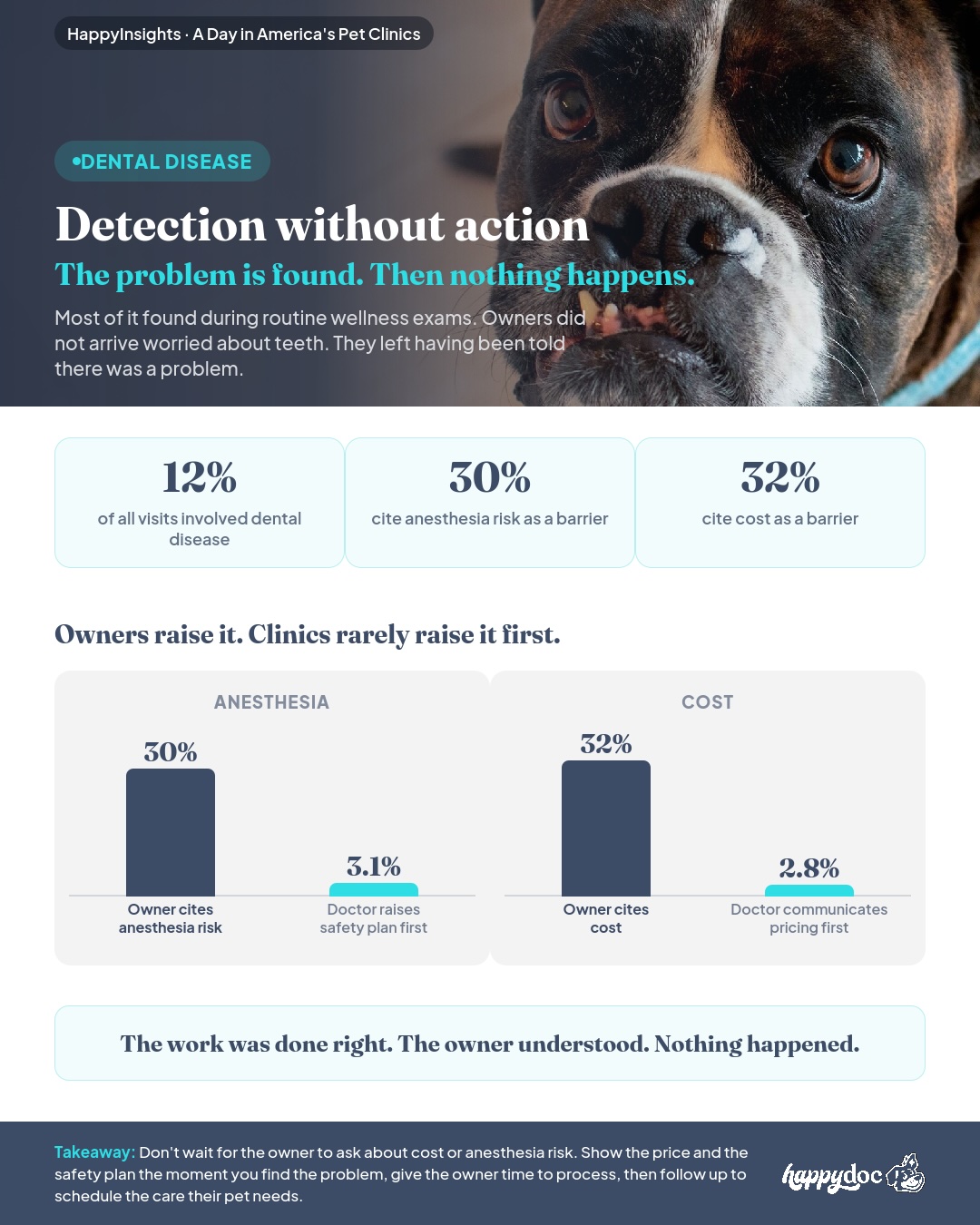
Dental disease appeared in nearly 12% of all visits in the dataset, with confirmed diagnoses including gingivitis and tartar buildup. The majority were discovered during routine wellness exams rather than as presenting complaints. Owners did not come in worried about their pet's teeth. They left having been told there was a problem.
And then, in most cases, they did not move forward with treatment.
Anesthesia risk appeared in 30% of dental visits. Cost concerns appeared in another 32%. These two barriers arrived together consistently, creating a situation where the clinician has done the diagnostic work correctly, the owner understands the problem, and nothing happens anyway.
Veterinarians addressed dental health proactively in only 3.1% of dental visits and engaged on pricing in only 2.8% of others. These conversations are still happening reactively, at the point of plan presentation, when anesthesia anxiety and sticker shock are already active.
Industry Implication?
Pre-visit anesthesia risk stratification, communicated to owners before they arrive, would lower the emotional temperature of the treatment conversation. Transparent cost modeling at the point of diagnosis, embedded directly into SOAP notes rather than added at the point of estimate, would reduce the sticker shock that drives deferral. When SOAP notes carry cost context forward through the visit, the treatment conversation becomes an extension of a discussion the owner has already had time to process.
Parasite Prevention: The Compliance Gap Is a Communication Gap
Parasite prevention generated nearly 12% of all visits in the dataset, and the data here told a clear story: veterinarians are making the right recommendations, and a significant number of clients are filling those prescriptions somewhere else.
Simparica Trio, Bravecto, and NexGard led prescription patterns consistently, but those same products appeared far more frequently in owner discussions than in clinical prescriptions, indicating that clients were already thinking about alternative sourcing before the recommendation was made.
Cost concerns appeared in 24% of parasite prevention visits. Chewy, Amazon, and Costco were mentioned across nearly 2% of all visits in the dataset. In 7% of parasite prevention appointments, owners explicitly sourced products elsewhere before or after the visit.
Flea infestation, flea allergy dermatitis, and tapeworm infection in the same dataset are not coincidences. They are downstream consequences of prevention lapses that are, in large part, downstream consequences of unaddressed price concerns.
Industry Implication?
Owners are not shopping elsewhere because they distrust the veterinarian's recommendation. They are doing it because no one made the case for why clinic pricing is worth the difference. Practices that proactively addressed pricing during parasite prevention visits had measurably better compliance. Only 3% of parasite prevention visits showed that happening.
The prevention-compliance gap is a communication gap. And it is one that better-supported clinical workflows can close.
Mass Monitoring: Decision Paralysis in the Exam Room
Lipomas and suspicious masses were discussed in 13% of all visits. The clinical findings were relatively benign overall: lipomas dominated diagnoses, with mast cell tumors appearing in only a small fraction of cases. But the emotional and financial complexity of these appointments was substantial.
Prognosis concerns appeared in 18% of mass-related visits. Anesthesia risk surfaced in 17%. Cost constraints were present in 13%. These three factors arrived together consistently, creating decision paralysis at exactly the moment where action is often most clinically appropriate.
Pain management emerged as a secondary priority in mass-related visits, with gabapentin and carprofen appearing regularly as clinicians managed discomfort from masses or concurrent arthritis rather than pursuing biopsy or removal, often because owners could not reconcile the cost and anesthesia risk with a finding that looked benign.
Industry Implication?
AI-powered mass tracking tools that stratify lipomas from higher-risk lesions, integrated with cost-benefit scenario modeling, would reduce the ambiguity that drives deferral and help clinicians and owners reach decisions with greater confidence.
What This Means for the Industry
Across every category in this analysis, the most common barrier to better care was not clinical. It was conversational. The knowledge was there. The diagnosis was often made correctly. The recommendation was sound. What broke down was the pathway from recommendation to action, and what most consistently blocked that pathway was cost uncertainty, anesthesia anxiety, or the absence of a proactive conversation that could have addressed either.
AI in veterinary medicine is not a replacement for the clinical judgment this data reflects. It is the infrastructure that makes better conversations possible at scale. When SOAP notes are structured to flag cost-sensitive diagnoses early, when pre-visit communication addresses anesthesia risk before owners arrive already anxious, when wellness workflows surface dental and weight management talking points before the appointment ends, the gap between best-practice care and real-world delivery narrows.
That is what HappyDoc is built to do. And HappyInsights exists to show, in data, where the work is most needed.
What Is HappyInsights?
Every appointment at your clinic is a conversation: between your doctors and your clients, your team and your goals, your services and your revenue. Until now, most of that conversation disappeared the moment the visit ended.
HappyInsights changes that.
HappyInsights is HappyDoc's practice intelligence platform. It takes the AI-generated SOAP notes and exam documentation your team is already producing and turns them into a living, weekly intelligence report for your clinic. No extra steps. No manual data entry. No consultant required. The information was always there inside your visits. HappyInsights surfaces it.
Each week, your HappyInsights report shows you:
Revenue you are leaving on the table. Missed charges, unbilled services, and clients who declined due to cost, including whether payment plans were offered during those conversations.
Patient satisfaction signals. Praise, complaints, unanswered client questions, and net satisfaction trends across every visit, so you can see how the client experience is tracking week over week.
Dental and wellness plan performance. Recommendation rates, acceptance rates, and which doctors on your team are leading the way, broken down clearly enough to act on.
A prioritized action plan. Specific, data-backed steps your team can take in the coming week, tied directly to your clinic's own goals.
One clinic using HappyInsights discovered that 18 clients had declined services due to cost in a single week, but payment plans were mentioned in only 3 of those conversations. That one insight alone represented thousands of dollars in recoverable revenue. Another clinic found that their dental recommendation rate had fallen from 62.5% to 45% over six weeks, and could see exactly which visits and which doctors were driving the shift.
This is the kind of clarity that used to require a consultant. Now it updates automatically, every week.
Just as HappyDoc was the first to build a veterinary-specific AI scribe, HappyInsights is the first AI advisor built specifically for the business of running a veterinary clinic. No other tool in the market does this.
👉 Learn more about HappyInsights >
How Did We Build This Report with HappyInsights?
The industry report you are reading was built using the same underlying capability that powers HappyInsights for individual clinics, applied at a much larger scale.
HappyDoc's AI in veterinary medicine platform generates structured SOAP notes across thousands of clinic visits every day. Those notes capture not just clinical findings but the full texture of the exam encounter: what the owner was worried about, what products were discussed, what recommendations were made, what objections came up, and what was ultimately decided.
For this report, we took a single day from early summer 2026 and looked across 2,000 anonymized visits from 286 clinics simultaneously. This is enough data to surface statistically significant trends. All identifying information was removed before analysis. No clinic names, no doctor names, no client or patient information of any kind was retained. What remained were patterns: clinical categories, owner concern signals, medication mentions, cost-related behaviors, and communication patterns, aggregated and analyzed to surface what a single day in American veterinary medicine actually looks like from the inside.
The categories in this report, from senior pet care to dental disease to parasite prevention, were not chosen in advance. They emerged from the data. Each section reflects a cluster of visits that shared enough characteristics to tell a coherent story about a specific area of care.
For individual clinics, HappyInsights does this same kind of analysis every week, but focused on your practice, your doctors, your clients, and your goals. The industry report is what it looks like when that lens is widened to see the whole field.
👉 See what an example HappyInsights report for a single clinic looks like >
FAQ: What America's Pet Clinics Told Us About Cost, Care, and Communication
Our report, "A Day in America's Pet Clinics," analyzed 2,000 anonymized veterinary visits from 286 clinics on a single day in early summer 2026. Here are the questions we kept getting asked about the findings, answered straight from the data.
Cost and Care
What percentage of veterinary visits show cost as a top owner concern? Cost surfaced as the top owner concern in more than 15% of all visits in the dataset, making it the single most pervasive factor across every clinical category we analyzed.
Where are pet owners buying medications instead of at the clinic? Chewy, Costco, and Amazon came up repeatedly as places owners planned to buy the exact medications and preventive products their vet had just recommended, often on the same day as the visit.
How often do vets bring up cost before the owner does? Rarely. Proactive cost conversations showed up in just 3% of wellness visits, 3% of dental visits, and 3% of parasite prevention visits, rising to 8% in vaccination visits. The pattern held across categories: cost gets discussed reactively, usually right when the owner is deciding whether to decline care.
Senior Pet Care
What share of veterinary visits involve senior pets? 28% of all visits in the dataset involved senior pets, the largest single life-stage segment we found.
What are the most common complaints in senior pet visits? Lethargy (11% of senior visits) and weight loss (10%) topped the list, followed by arthritis, heart murmurs, and dental disease, each appearing in roughly 9% of senior diagnoses.
What's the most frequently prescribed medication overall? Gabapentin, appearing in nearly 5% of all visits in the dataset, more than any other medication.
What worries owners most during senior pet visits? Prognostic uncertainty topped the list at 27% of senior visits, followed by cost barriers (14%) and anesthesia risk (14%).
Vaccination
What percentage of vaccine-related visits are scheduled specifically as vaccine appointments? Only 21%. Nearly half were scheduled as wellness exams instead, with vaccine updates driving another 32%. Vaccination is still bundled into routine care rather than treated as its own priority.
What percentage of owners cite cost as a concern in vaccine-related visits? 42%, the dominant owner worry in vaccine-adjacent visits, ahead of side effects, necessity, or safety questions.
How many owners raise concerns about vaccine side effects? 19% of vaccine-related visits.
Wellness Visits
What's the single largest category of veterinary visits? Wellness visits, accounting for 17% of all appointments in the dataset.
What gets found incidentally during wellness exams? Dental disease was the most common incidental finding, showing up in roughly 5% of wellness diagnoses, alongside weight concerns in 6% of wellness visits.
Do owners bring up unrelated issues during wellness visits?O ften. Anxiety medications like gabapentin and trazodone showed up regularly in otherwise routine wellness appointments, suggesting owners save behavioral questions for these scheduled check-ins rather than booking a separate visit.
Chronic Allergies
Which clinical category shows the highest rate of cost concerns? Chronic allergy management, at 27% of visits, the highest of any category in the report.
What does owner frustration with allergy management actually sound like? Phrases like "we kind of gave up" and "this was my last hope" showed up repeatedly, not as outliers but as a pattern reflecting fatigue with a condition that rarely fully resolves.
What medications dominate allergy treatment conversations? Cytopoint and Apoquel led the therapeutic conversation, though medication side-effect concerns and doubts about effectiveness each came up in 8% of allergy visits.
Dental Disease
What are the two biggest barriers to owners approving dental treatment? Anesthesia risk and cost, tied at 30% of dental visits each. Most dental disease is found incidentally during a wellness exam, not because the owner came in worried about it, and then treatment stalls.
How often do vets proactively address dental costs or anesthesia risk? Only about 3% of the time for each, meaning most of these conversations happen reactively, right when the treatment plan is presented.
Parasite Prevention
Are owners filling parasite prevention prescriptions at the clinic that recommended them?N ot consistently. Simparica Trio, Bravecto, and NexGard led clinical recommendations, but those same products came up far more often in owner conversations about buying them elsewhere, at Chewy, Amazon, or Costco.
What percentage of parasite prevention visits show cost concerns?2 4%, and 7% of those visits included owners explicitly saying they'd source the product outside the clinic.
Mass Monitoring
How common are conversations about lumps and masses?They came up in 13% of all visits in the dataset, most often benign lipomas.
What stops owners from moving forward with a biopsy or removal?A combination of prognosis concerns (18% of mass-related visits), anesthesia risk (17%), and cost (13%). Together, they create real decision paralysis, even when the finding looks clinically low-risk.


.png)

.png)


