




What Is OpenVet? A Practical Guide for Veterinarians (and How to Pair It With HappyDoc)
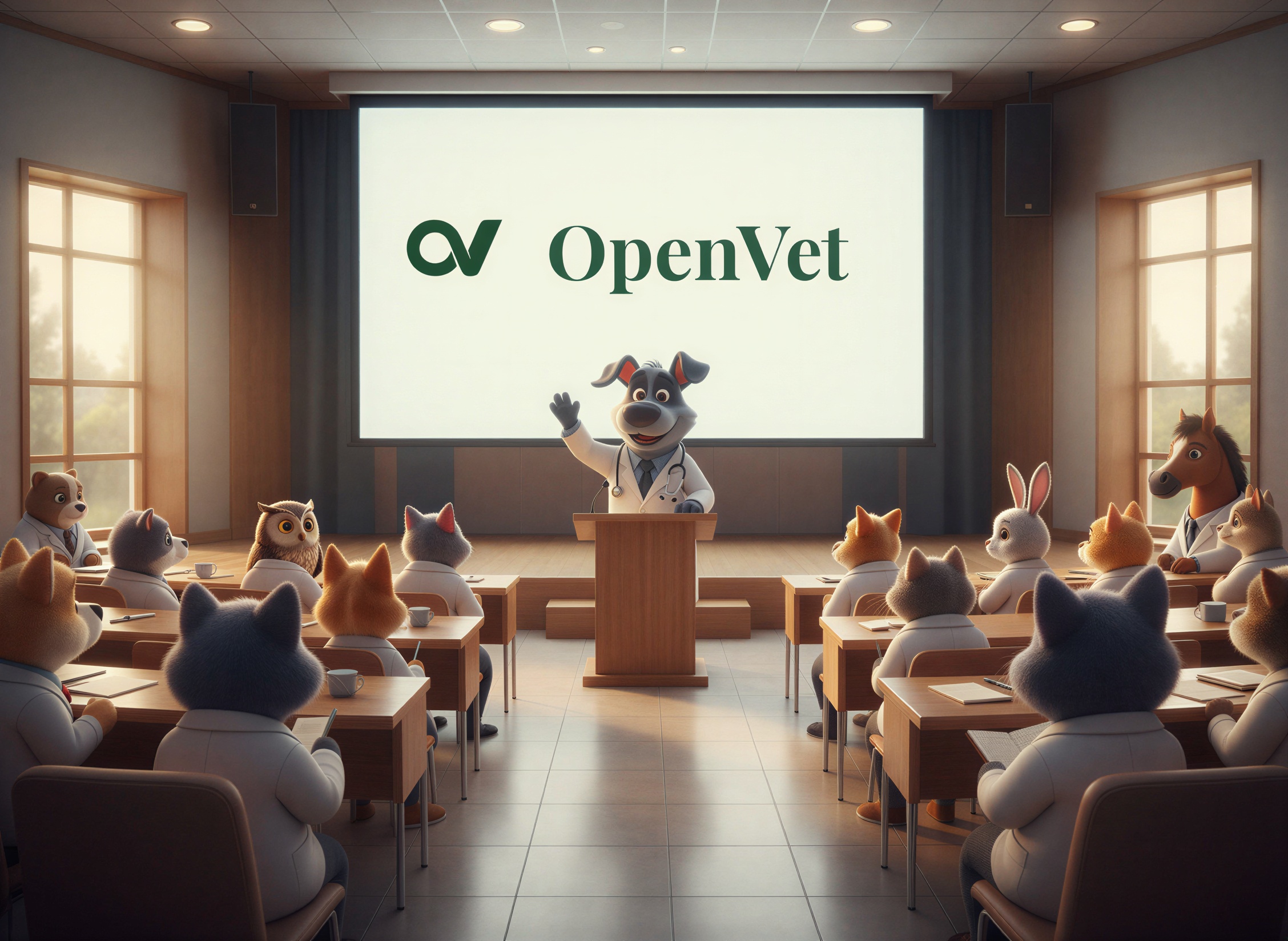
Summary: OpenVet is an AI clinical reasoning platform built for veterinarians, offering cited, species-aware answers to clinical questions across companion animals, exotics, and beyond. It is free for licensed vets and is designed to support decision-making, not documentation. HappyDoc handles the other half of the appointment: capturing the conversation and writing an accurate SOAP note back into your PIMS. Used together, they cover thinking and recording without asking your team to replace anything they already run.
What Is OpenVet?
OpenVet is an AI clinical reasoning platform for licensed veterinarians. Instead of returning a generic answer to a clinical question, it produces a structured response with citations, stated assumptions, and suggested next steps, adapted to the species in front of you.
The company describes itself as building a health system for every species on earth. In practice, what a veterinarian experiences is closer to a specialist consult that is available in under a minute: ask about IRIS staging for a 12-year-old cat with a creatinine of 3.4, early intervention for rabbit GI stasis, or a dosing question for acute pancreatitis in a 32kg dog, and the system returns a reasoned answer with sources attached.
Three things distinguish it from a general-purpose chatbot:
Species-aware reasoning. Coverage spans canine, feline, lagomorph, avian, and aquatic species, plus exotics and wildlife, with physiology and pharmacokinetics adjusted accordingly. Medical coverage includes emergency, internal medicine, surgery, toxicology, oncology, cardiology, dermatology, behavior, and pain management, among others.
Deterministic drug data. Per OpenVet's published Safety Charter, drug doses are validated against a verified formulary rather than generated by the language model, and species-specific safety checks run before output.
Clinical oversight. OpenVet lists named clinical leadership, including Chief Veterinary Officer Natalie Marks, DVM, CVJ, and advisors such as Fred Wininger, DVM, MS, DACVIM (Neurology). Clinical content is reviewed by qualified veterinarians before release.
Access is free for veterinarians, and every account is tied to a license number captured at sign-up.
How OpenVet Fits Into a Clinical Workflow
The pattern OpenVet is built around is: question, patient context, structured answer.
You can ask a standalone question, but the platform is designed for you to attach case context. History, labs, medications, imaging notes, and prior diagnoses can be added so the reasoning reflects the actual animal rather than a textbook average. Over time, those attached cases accumulate into a longitudinal record for that patient.
That has a practical implication worth calling out for practice managers. OpenVet's privacy documentation states that standalone queries stay visible only to the veterinarian who asked them, and that attaching a query to a patient record is the action that makes it visible to the practice team. If you plan to standardize on OpenVet across a group, that visibility boundary is worth understanding before rollout.
On security posture, OpenVet publishes a live compliance table listing TLS 1.3 in transit, AES-256 at rest, MFA support, US data residency, and a 72-hour breach notification commitment. It applies HIPAA-comparable controls by choice while noting that HIPAA does not govern veterinary records, and it does not sign BAAs.
What OpenVet Is Not
Clear boundaries make it easier to decide where a tool belongs in your stack.
It is not a PIMS. OpenVet does not handle scheduling, invoicing, inventory, reminders, or client communication. The company draws this line itself: your practice information management system runs the business, and OpenVet runs the medicine.
It is not a replacement for clinical judgment. OpenVet's own charter states that the veterinarian remains responsible for the decision, and its interface reminds users that the system can make mistakes.
It is not, in its primary positioning, a documentation system for your medical record. OpenVet builds a case record inside its own platform. That is a different artifact from the SOAP note that has to land in AVImark, Cornerstone, or ezyVet and stand up to a board complaint three years from now.
That last distinction is where a documentation layer becomes relevant.
Where HappyDoc Fits: The Documentation Layer
HappyDoc is a veterinary AI scribe and assistant. It listens to the appointment as it happens, generates a structured SOAP note, and writes that note back into the PIMS your clinic already runs.
The differences that matter operationally:
- Bidirectional PIMS integration with AVImark, Cornerstone, ImproMed, Vetspire, Shepherd, ezyVet, DaySmart, and Pulse, with a browser extension fallback for systems outside that list. Patient history flows in, the finished note flows out.
- 99.8% production accuracy, built on training across more than 2 million real veterinary appointments.
- SOC 2 Type II certification, which is typically the first item procurement asks for at the multi-site level.
- Scout, HappyDoc's built-in analytics layer, which surfaces clinic-wide documentation and appointment trends from the record itself.
As HappyDoc's breakdown of veterinary EMR vs. PIMS explains, most clinics do not need another system of record. They need better support around the work already happening inside the systems they run. That principle applies equally to OpenVet and to HappyDoc: both are layers, not replacements.
Note that HappyDoc and OpenVet are separate companies, and there is no announced native integration between the two products. What follows is a workflow pattern, not a technical handshake.
Using OpenVet and HappyDoc Together: A Side-by-Side Appointment
Here is what a single complicated visit looks like when both layers are running.
Moment in the appointmentHappyDocOpenVetClient walks in, history taking beginsRecording starts; prior visit context pulled from the PIMSIdleExam reveals an unexpected findingContinues capturing the exam narrativeVet asks a differential or staging question, gets a cited answerDiscussing a treatment plan with the clientCaptures the plan as it is verbalizedConfirms a species-appropriate dose against verified formulary dataAppointment endsSOAP note generated and written back to the PIMSCase context saved for follow-upRecheck in three weeksPrior note available in the PIMS automaticallyLongitudinal case picture available for the next reasoning pass
The division of labor is clean. OpenVet is consulted at the moments of uncertainty. HappyDoc is running continuously in the background so that whatever you decide is captured accurately without you retyping it at 7 p.m.
One practical tip: whatever conclusion you reach with OpenVet, say it out loud to the client. Not only is that good communication practice, it means the reasoning lands in the note automatically. HappyDoc's guide to what an AI scribe captures during a visit covers this in more detail: the scribe documents what is discussed, so verbalizing your reasoning is the cheapest way to get a defensible record of it.
Why Two Layers Beat One All-in-One Tool
Veterinary teams are stretched thin, and the pressure is well documented. The Merck Animal Health Veterinarian Wellbeing Study III, conducted with the AVMA, found that burnout remained at high levels among veterinarians and that support staff scored higher in burnout than veterinarians did. Labor shortages were a meaningful driver.
That context shapes how tools should be evaluated. The instinct is often to look for one platform that does everything. In veterinary medicine, that instinct tends to produce disappointment, because the categories are genuinely different engineering problems. Reasoning over clinical evidence and writing structured data into a legacy Windows PIMS have almost nothing in common technically.
A layered stack works better:
- PIMS layer: the system of record for scheduling, billing, inventory, and stored charts.
- Clinical reasoning layer: OpenVet, consulted for differentials, dosing, staging, and evidence.
- Documentation layer: HappyDoc, capturing the visit and writing the note back into the PIMS.
- Analytics layer: Scout, turning the accumulated documentation record into operational visibility.
Each layer can be adopted, evaluated, or replaced independently. Nothing in this arrangement requires migrating a PIMS, which is the single most disruptive project a practice can undertake. For a broader view of how these layers stack up, see HappyDoc's guide to the best veterinary AI scribe options in 2026.
Questions to Ask Before Adding Either Tool
- Who on the team is expected to use the clinical reasoning tool, and will their queries be visible to practice leadership?
- Does the documentation tool write back into our specific PIMS, or does it stop at generating text we still have to paste?
- What happens to our data if we cancel? Both vendors publish deletion policies; read them.
- Are we solving a documentation problem, a clinical confidence problem, or both? The answer determines the order of adoption.
Frequently Asked Questions
Is OpenVet free? OpenVet states that access is free for licensed veterinarians, with sign-up requiring a license number. Confirm current terms directly at openvet.ai.
Does OpenVet replace my PIMS? No. OpenVet explicitly positions itself alongside the PIMS rather than in place of it. Scheduling, invoicing, inventory, and reminders remain in your practice management system.
Can OpenVet write my SOAP notes into AVImark or Cornerstone? Writing structured notes back into a PIMS is the function of a dedicated documentation tool. HappyDoc offers bidirectional write-back across major PIMS platforms, which is what keeps the medical record current without manual copy and paste.
Do OpenVet and HappyDoc integrate directly? There is no announced native integration between the two products. They are used in parallel during the same appointment, each handling a different part of the workflow.
Which should a practice adopt first? If after-hours charting is the bottleneck, start with documentation. If clinical confidence on unusual cases is the bottleneck, start with reasoning support. Most practices feel the documentation burden first, which is why documentation technology has become a practice essential.
Bring the Documentation Layer Into Your Stack
Better clinical reasoning is worth very little if the reasoning never makes it into the chart. If your team is already exploring AI tools for clinical support, the documentation layer is the piece that makes the rest of it durable.
Book a demo with HappyDoc and we will walk through exactly how the AI scribe fits your current PIMS, your templates, and your appointment flow. You can also see how the AI scribe works before you talk to anyone.


.png)
.png)


